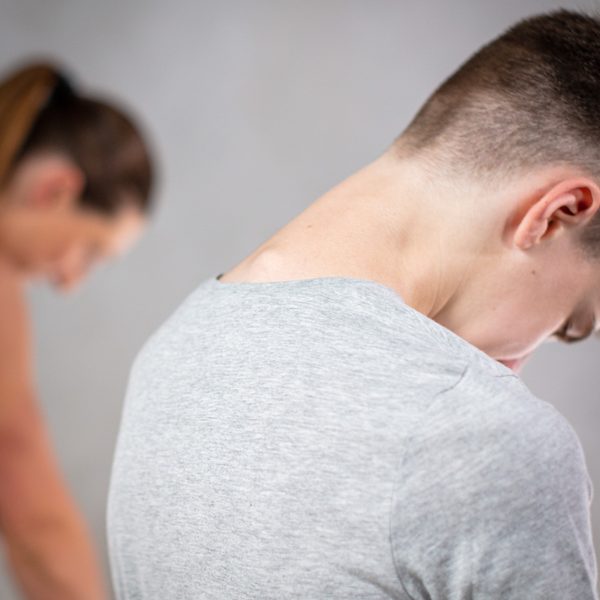
How it shows up
In profile the ear sits well ahead of the shoulder, the chin tips slightly up and a sharp crease forms at the back of the neck. A rounded upper back and shoulders rolled forward usually come with it — it rarely appears on its own.
The wall test: stand with heels, buttocks and shoulder blades against a wall. If the back of the head does not reach the wall, or only by tipping the head back, the head is carried forward. Best to have someone photograph you from the side — in a mirror you straighten up without noticing and see nothing.
Where it usually comes from
For every centimetre the head moves forward, the neck takes on several extra kilos — the lever gets longer while the weight of the head stays the same. That is where neck pain, headaches and tingling down the arm come from; forward head posture is their common denominator.
It builds wherever you look down or forward for hours: a monitor below eye level, a phone in your lap, reading in bed, driving. What matters is that the head moves forward as an answer to a rounded chest — when the thoracic spine bends, the eyes would point at the floor, so the head compensates forward and up. That is why tucking the chin on its own is not enough.
How spiral stabilisation approaches it
The head returns above the body's axis by itself once the chest beneath it straightens. So spiral stabilisation does not start at the neck: first the shortened front is lengthened and the chains that draw the shoulder blades down and back are engaged. The thoracic spine straightens and the head no longer has a reason to go forward.
The exercises are done standing and in movement close to walking, because walking is where posture is either fixed in place or relearned — and everyone walks every day. Tucking the chin is useful as a reminder, but without a straightened chest the head has nowhere to return to.
When to see a doctor first
If tingling or weakness in the arm or hand appears, or dizziness, vision problems or trouble with balance. In children and teenagers always, if posture changes quickly or cannot be straightened voluntarily — a rigid curve is not a habit and is handled differently.
Related exercises
Exercises done for forward head posture. You can read about them here; the full instructions and video are in the Spiralista app.
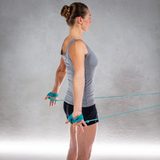
B3 Arrow
Arrow front standing
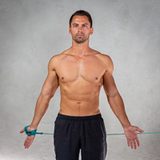
B9 Sideway Arrow
Sideway Arrow standing
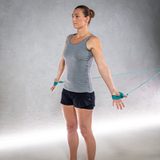
B10 Back Arrow
Back Arrow standing
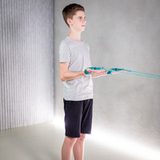
B1 Book
Book front standing
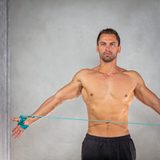
B5 Hitchhiker
Hitchhiker sideways standing
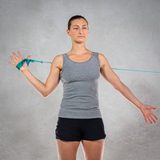
L19 Hello
Hello sideways standing
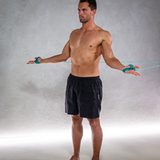
B8 Back Scales
Back Scales standing
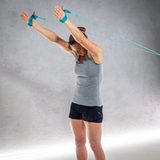
B11 Circles
Circles back standing
What to do about it
A guide in the Spiralista app takes you through the exercises for this condition day by day — from the first exercise to the full sequence.
- At homeAn elastic cord and a bit of wall space are enough.
- ShortA few minutes a day, not an hour in the gym.
- Day by dayThe guide shows what comes next today.