How it shows up
Seen from the side in standing, there is a pronounced arch in the lower back, the belly forward and the buttocks back. Lying on your back, a whole hand fits under the lower back even with the legs straight. Trousers stand away at the back and cut in at the front.
On its own it does not hurt, which is why it is overlooked for years. What comes is fatigue in the lower back after standing, morning stiffness and in time lower back pain — that one does come out of the position.
Where it usually comes from
The pelvis is held upright by a pair of pulls: the abdominals and hip flexors at the front, the glutes and spinal extensors at the back. Sitting shortens the hip flexors and switches the glutes off. The shortened front then tips the pelvis forward, and the lower back has to arch to keep the torso vertical.
So it is not a weak abdomen, as is often said. It is an imbalance of pulls — and strengthening the abdomen by curling up usually deepens it, because the hip flexors work hardest in exactly that movement.
How spiral stabilisation approaches it
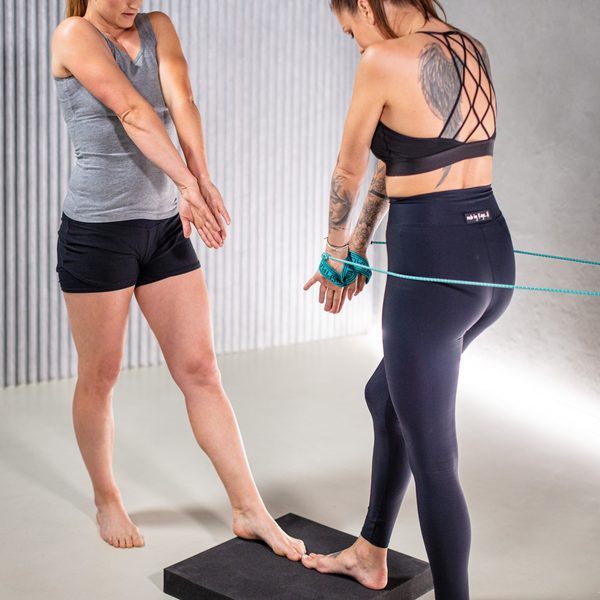
Spiral stabilisation brings the pelvis back to vertical by engaging the opposing pull: the oblique abdominals and the glutes in one chain with the arm on the other side. The lower back is not forced flat against the floor — it straightens because someone else takes over its work.
At the same time the front of the hip is lengthened, because without that the pelvis cannot return. The exercises are done standing: lying down hides the arch and the exercise then does not correct what needs correcting.
When to see a doctor first
An examination is needed where the arch is increasing quickly in a child or teenager, where pain at night or at rest joins in, where a leg is getting weak or numb, and always after a fall.
In pregnancy the lower back arches naturally; exercising is possible, but the routine should be approved by a doctor or physiotherapist who knows about the pregnancy.
Related exercises
Exercises done for a hollow back. You can read about them here; the full instructions and video are in the Spiralista app.
B3 Arrow
Arrow front standing
B9 Sideway Arrow
Sideway Arrow standing
B10 Back Arrow
Back Arrow standing
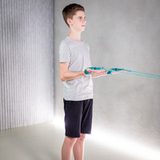
B1 Book
Book front standing
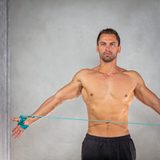
B5 Hitchhiker
Hitchhiker sideways standing
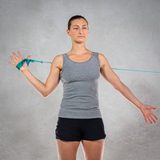
L19 Hello
Hello sideways standing
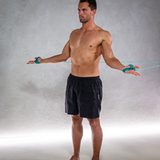
B8 Back Scales
Back Scales standing
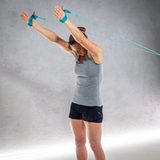
B11 Circles
Circles back standing
What to do about it
A guide in the Spiralista app takes you through the exercises for this condition day by day — from the first exercise to the full sequence.
- At homeAn elastic cord and a bit of wall space are enough.
- ShortA few minutes a day, not an hour in the gym.
- Day by dayThe guide shows what comes next today.