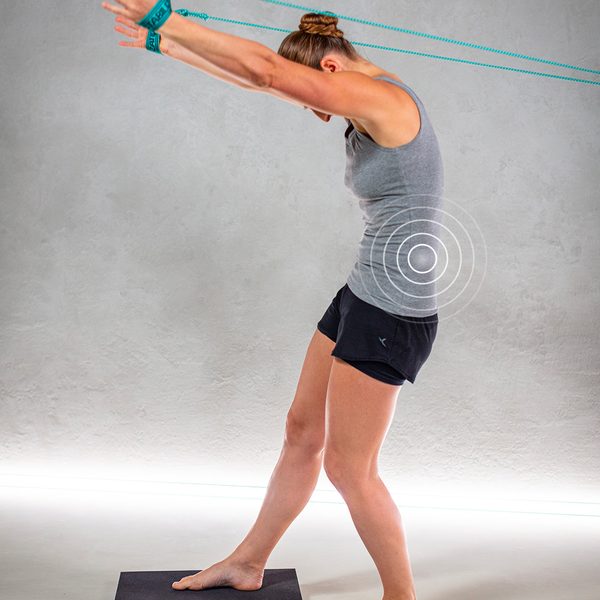
How it shows up
A dull or sharp pain low in the back, above the pelvis. It typically announces itself when getting up in the morning, after sitting for a long time, or when straightening up from a bend. Sometimes it stays on one side, sometimes it spans the whole lower back.
A telling sign: one position relieves it and another brings it straight back. That points to how the body is held rather than to damaged tissue. If the pain shoots down the leg or tingles, start with the article Intervertebral Disc Herniation.
Where it usually comes from
The lumbar spine carries the weight of the whole torso and has the least support of any section. Sitting tips the pelvis backwards and loads the discs in a way they are not built for. Lifting from a bend multiplies that load.
Then comes one-sidedness — the bag always on the same shoulder, working with the torso turned one way, sleeping in a single position. The muscles around the spine stop working symmetrically and the skeleton takes over work that belongs to them.
How spiral stabilisation approaches it
The spiral stabilisation method works from the idea that the spine can be unloaded by the pull of muscle chains running diagonally across the torso. When they engage, the spine lengthens upwards and the discs get room — instead of being compressed.
That is why the exercises are done standing and in movement close to walking, not by strengthening the back muscles lying down. A braced back compresses the lumbar spine, which is exactly what lower back pain does not need.
When to see a doctor first
If the pain radiates into the leg, if there is weakness or tingling there, if it started after a fall or an injury, or if it has lasted more than a few weeks without improving. Examination comes before exercise, not after.
Related exercises
Exercises done for lower back pain. You can read about them here; the full instructions and video are in the Spiralista app.
B1 Book
Book front standing
B5 Hitchhiker
Hitchhiker sideways standing
B8 Back Scales
Back Scales standing
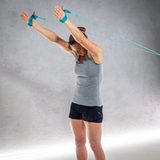
B11 Circles
Circles back standing
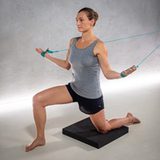
C31 Back Fencer
Back Fencer kneeling
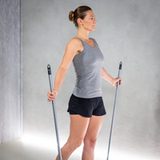
D33 Front Flamingo
Front Flamingo standing
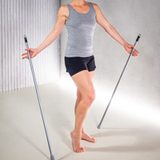
E43 Tourist
Tourist front shifting weight
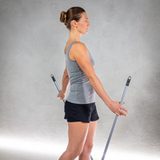
D34 Flamingo with wings
Flamingo with wings front standing
What to do about it
A guide in the Spiralista app takes you through the exercises for this condition day by day — from the first exercise to the full sequence.
- At homeAn elastic cord and a bit of wall space are enough.
- ShortA few minutes a day, not an hour in the gym.
- Day by dayThe guide shows what comes next today.