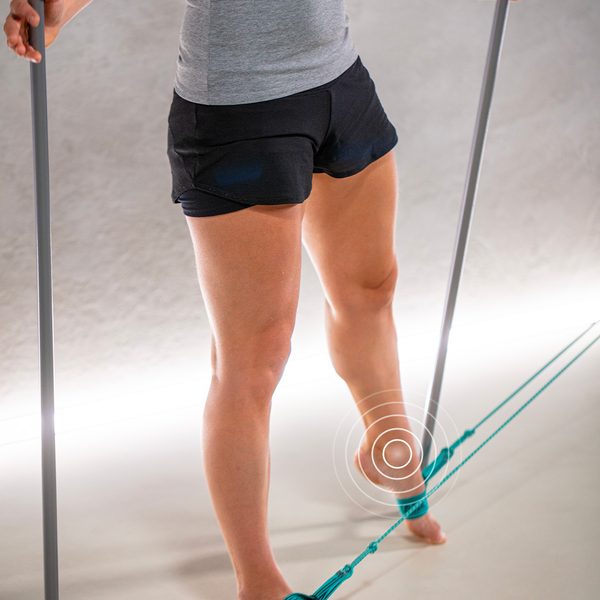
How it shows up
The pain sits on the outer side of the ankle, sometimes at the front as well. It comes after a longer walk, after running on uneven ground, after a day on your feet in unsupportive shoes. There is often mild swelling around the ankle that disappears overnight and returns in the afternoon.
The strongest symptom, though, is the sense of uncertainty: you watch your feet, slow down at a kerb and do not trust yourself on rough ground. That feeling is not lying — the ankle really does react more slowly than the other one.
Where it usually comes from
A sprain overstretches the ligaments on the outer side. They heal, but along with them the sensors that report the joint's position to the brain are damaged too. Those do not restore themselves — so the ankle receives the command to protect itself a fraction of a second later than it should.
That is why sprains repeat. It is not a weak joint but a slower connection; calf strength changes nothing unless the timing and the stability of the whole leg from the pelvis down improve.
How spiral stabilisation approaches it
Spiral stabilisation works with the whole leg, not the ankle. Chains running from the torso through the hip to the foot teach the leg to stand in line and the foot to rest on three points. The ankle then takes load straight down rather than from the side.
The work is done standing and walking, because that is where timing is decided. Balance work on one leg only helps once the pelvis above it holds — otherwise it just rehearses the same deviation.
When to see a doctor first
After a fresh injury see a doctor if you cannot put weight on the foot, if swelling appears within minutes, if the ankle looks deformed, or if the bone on the edge of the ankle hurts — pain does not tell a fracture from a sprain.
Also if swelling and pain last more than a few weeks, if the ankle locks repeatedly, or if fever and redness appear.
Related exercises
Exercises done for ankle pain. You can read about them here; the full instructions and video are in the Spiralista app.
B3 Arrow
Arrow front standing
B9 Sideway Arrow
Sideway Arrow standing
B10 Back Arrow
Back Arrow standing
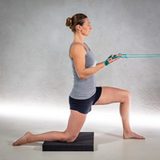
C29 Front Fencer
Front Fencer kneeling
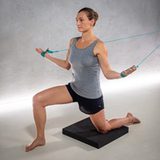
C31 Back Fencer
Back Fencer kneeling
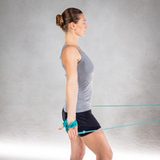
E3 Arrow
Arrow front shifting weight
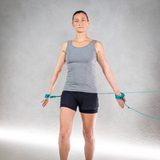
E9 Sideway Arrow
Sideway Arrow shifting weight
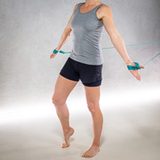
E10 Back Arrow
Back Arrow shifting weight
What to do about it
A guide in the Spiralista app takes you through the exercises for this condition day by day — from the first exercise to the full sequence.
- At homeAn elastic cord and a bit of wall space are enough.
- ShortA few minutes a day, not an hour in the gym.
- Day by dayThe guide shows what comes next today.