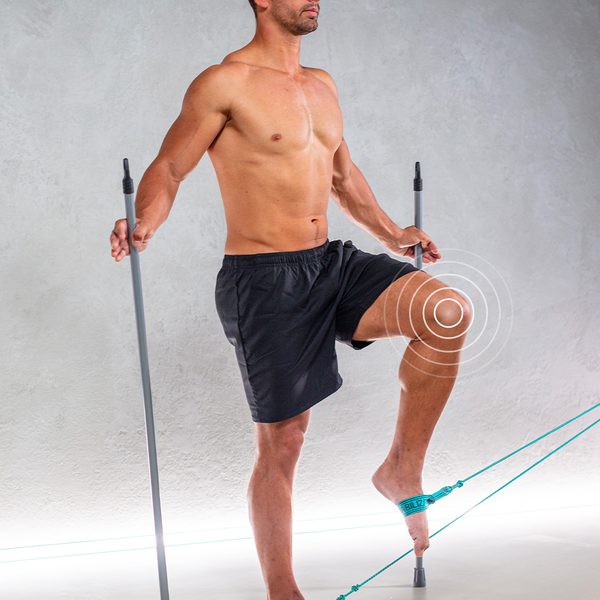
How it shows up
Most often it hurts at the front, around or under the kneecap. It comes with squatting, with walking down stairs and after sitting a long time with the leg bent — anyone in a cinema or a car wants to straighten the leg after a while.
Clicking is common, along with a feeling that the knee 'slides' sideways. Swelling is small or absent; a knee that is swollen and warm is a different question and belongs to a doctor.
Where it usually comes from
The knee is a joint that essentially only bends and straightens. It can barely move sideways or rotate — and that is precisely what the body asks of it when the pelvis tilts or the foot rolls inward. The axis between hip and foot breaks, and the kneecap stops travelling in its groove.
Hence the pain at the front, the clicking, and the fact that the body produces the force to straighten from one muscle instead of all of them. Strengthening the thigh alone will not fix it — it does not straighten the axis.
How spiral stabilisation approaches it
Spiral stabilisation straightens the axis from above and from below. The chains from one shoulder to the opposite hip keep the pelvis vertical, the pull across the whole body unloads the knee with every step, and the foot learns to stand on three points rather than on its inner edge.
The work is done standing and walking, because that is where the axis breaks. Once the knee gets a straight path, it stops hurting without anything being done to the knee itself.
When to see a doctor first
See a doctor if the knee swells within hours, if it is warm and red, if it locks in a bent position or gives way, and always after an injury with swelling.
Also if the pain wakes you at night, if a fever appears, or if the range of movement is shrinking week by week.
Related exercises
Exercises done for knee pain. You can read about them here; the full instructions and video are in the Spiralista app.
C25 Reeds
Reeds back kneeling
B1 Book
Book front standing
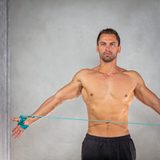
B5 Hitchhiker
Hitchhiker sideways standing
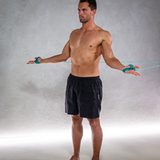
B8 Back Scales
Back Scales standing
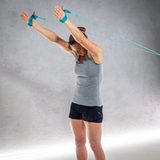
B11 Circles
Circles back standing
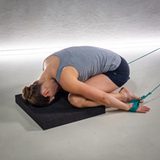
C27 Curl-Up
Curl-Up back kneeling
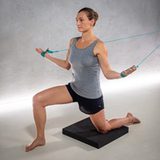
C31 Back Fencer
Back Fencer kneeling
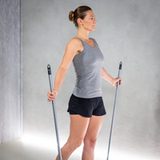
D33 Front Flamingo
Front Flamingo standing
What to do about it
A guide in the Spiralista app takes you through the exercises for this condition day by day — from the first exercise to the full sequence.
- At homeAn elastic cord and a bit of wall space are enough.
- ShortA few minutes a day, not an hour in the gym.
- Day by dayThe guide shows what comes next today.