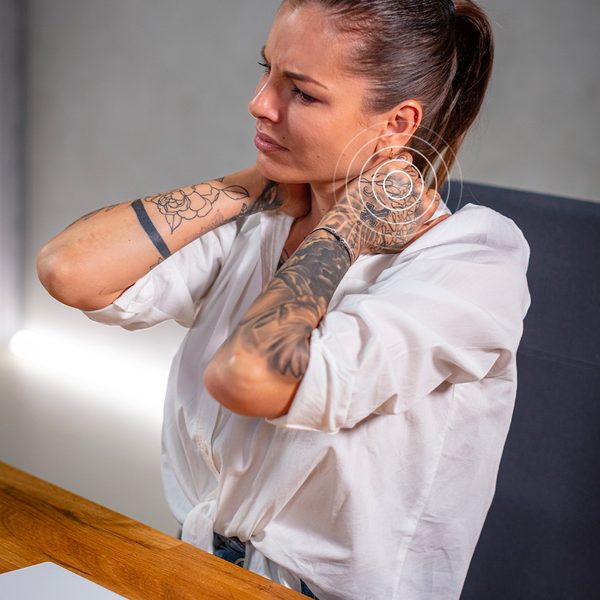
How it shows up
The neck turns to one side only, or stops short in both directions. The pain sits between the neck and the shoulder and gets worse towards evening. Often a headache joins in — one that starts in the neck and pulls above the eyes — or tingling that shoots down the arm.
The telling part: it does not get worse after sport, but after a day at the monitor.
Where it usually comes from
The head weighs around five kilos and short neck muscles hold it. The moment it moves in front of the body's axis — at a monitor, over a phone — the lever gets longer and those muscles have to pull several times harder. And they do it for hours a day, with almost no break.
The other half of the problem is the shoulders. At a keyboard they ride up towards the ears and stay there; the muscles between neck and shoulder shorten and stop letting go.
How spiral stabilisation approaches it
The key is not in the neck itself. When the muscles that pull the shoulder blades down and back engage, the chest opens and the head returns above the body's axis almost on its own — the neck no longer has to hold it out on a lever.
That is why spiral stabilisation uses arm pulls against resistance while standing, not head circles and not neck stretches. Releasing an overloaded muscle that is holding the head only switches it off for a while; an hour at the monitor brings it back.
When to see a doctor first
If there is weakness or tingling in the arm that does not settle, if the pain started after an injury (including a rear-end collision), or if dizziness, vision problems or balance trouble join in. The cervical spine sits close to the spinal cord — this is not the place to guess.
Related exercises
Exercises done for neck pain. You can read about them here; the full instructions and video are in the Spiralista app.
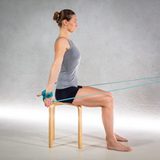
A3 Arrow
Arrow front sitting
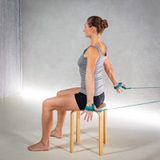
A10 Back Arrow
Back arrow sitting
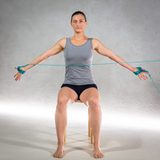
A5 Hitchhiker
Hitchhiker sideways sitting
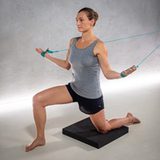
C31 Back Fencer
Back Fencer kneeling
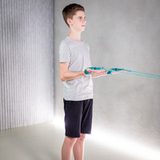
B1 Book
Book front standing
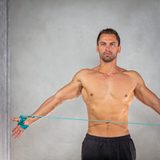
B5 Hitchhiker
Hitchhiker sideways standing
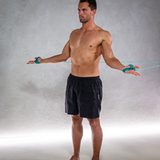
B8 Back Scales
Back Scales standing
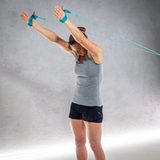
B11 Circles
Circles back standing
What to do about it
A guide in the Spiralista app takes you through the exercises for this condition day by day — from the first exercise to the full sequence.
- At homeAn elastic cord and a bit of wall space are enough.
- ShortA few minutes a day, not an hour in the gym.
- Day by dayThe guide shows what comes next today.