
How it shows up
The pain is sharp, well defined and you can point to it. It arrives with a deep breath, a cough, a sneeze or a twist of the torso — and at rest it is almost absent. Sometimes it runs from the spine forward along a rib, like a band.
Typically you start to fear breathing in. Shallow breathing gives the ribs no relief, quite the opposite: less movement means more stiffness, and the pain lasts longer than it needs to.
Where it usually comes from
Each rib is attached at the back to two vertebrae and rotates a little at that joint with every breath. It only takes one such joint to stop moving — after a sudden movement, after sleeping in an unusual position, after long work with the torso turned to one side — and the in-breath runs into it like a stop.
What hurts is the muscle and connective tissue around it, not the rib itself. That is why it is sharp, and also why it is usually a matter of days rather than months — provided the chest starts moving again.
How spiral stabilisation approaches it
The exercises do not try to put a rib back anywhere. They return movement to the whole rib cage: chains from the arms diagonally across the torso open it, and with every repetition the breath travels a greater distance than the body had grown used to.
You work in the range that does not hurt and add range gradually. Pushing through the stab makes no sense — the surrounding tissue would protect itself with more tension and the whole thing would drag on.
When to see a doctor first
See a doctor for rib pain after a fall or impact (a fracture cannot be told from the pain alone), with breathlessness, fever, a productive cough, coughing up blood, or if swelling and redness appear.
Watch out for shingles: pain in a band along a rib that starts before the rash. And as with the chest — crushing pain with breathlessness or sweating belongs in emergency care, not in an exercise routine.
Related exercises
Exercises done for rib pain. You can read about them here; the full instructions and video are in the Spiralista app.
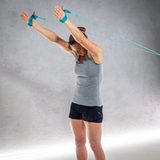
B11 Circles
Circles back standing
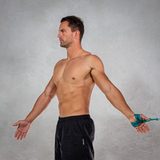
L12 Crawl
Crawl back standing
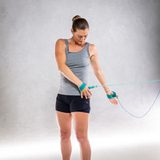
B15 Windshield Wipers
Windshield Wipers back standing
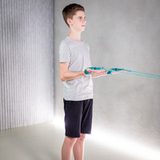
B1 Book
Book front standing
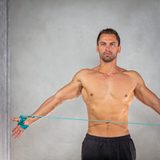
B5 Hitchhiker
Hitchhiker sideways standing
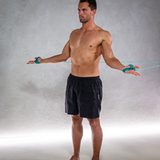
B8 Back Scales
Back Scales standing
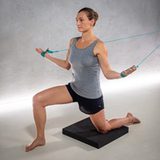
C31 Back Fencer
Back Fencer kneeling
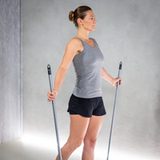
D33 Front Flamingo
Front Flamingo standing
What to do about it
A guide in the Spiralista app takes you through the exercises for this condition day by day — from the first exercise to the full sequence.
- At homeAn elastic cord and a bit of wall space are enough.
- ShortA few minutes a day, not an hour in the gym.
- Day by dayThe guide shows what comes next today.