How it shows up
Pain when lifting the arm above horizontal, when reaching behind you (a zip, the back seat of a car) or when lying on that side. Sometimes sharp at one point in the range with quiet above and below it — the so-called painful arc.
Over time stiffness joins in: the shoulder no longer only hurts on movement, it simply will not go. The body learns to work around it by hitching the whole shoulder up or leaning the torso, which deepens the problem.
Where it usually comes from
The shoulder is the most mobile joint in the body and pays for it with very little stability of its own. Muscles hold it, not the shape of the bones. Its socket sits on the shoulder blade — so when the blade is badly placed, the socket points somewhere it should not, and the tendons underneath get pinched every time the arm goes up.
That is why so many shoulders start hurting after years at a computer, with nothing having happened. The blade is drawn forward and up, the space under the bony arch narrows, and a movement made a hundred times a day begins to chafe. A sudden overload — painting a ceiling, a heavy pack, too much training — is then the last straw, not the cause.
How spiral stabilisation approaches it
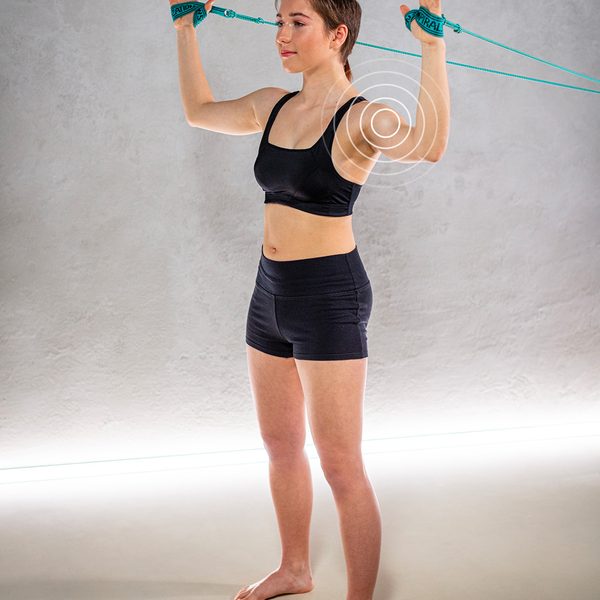
The shoulder blade has to be set right first; only then does training the shoulder make sense. Spiral stabilisation uses an arm pull against resistance, diagonally down and back: the blade seats itself on the ribs, the socket turns the right way and the space for the tendons opens. The painful arc often shrinks before any strength is gained.
What is not done: strengthening the shoulder with lateral raises while the blade is still misplaced. The load then runs straight through the spot that is chafing. Nor is there any 'loosening up' by swinging the arm through pain — a joint that hurts at one point in its range is only irritated by that.
When to see a doctor first
If the arm cannot be lifted at all, if the pain followed a fall or a sharp jerk (a tendon may be torn), if the shoulder is swollen, warm or visibly changed, or if there is weakness and tingling in the arm that does not settle.
Stiffness that grows quickly without any injury also belongs in front of a doctor — a frozen shoulder is treated differently and timing matters.
Related exercises
Exercises done for shoulder pain. You can read about them here; the full instructions and video are in the Spiralista app.
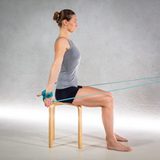
A3 Arrow
Arrow front sitting
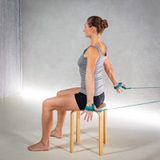
A10 Back Arrow
Back arrow sitting
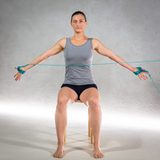
A5 Hitchhiker
Hitchhiker sideways sitting
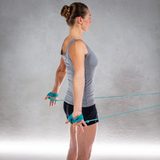
B3 Arrow
Arrow front standing
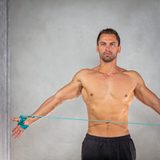
B5 Hitchhiker
Hitchhiker sideways standing
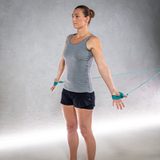
B10 Back Arrow
Back Arrow standing
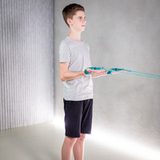
B1 Book
Book front standing

B2 Scales
Scales front standing
What to do about it
A guide in the Spiralista app takes you through the exercises for this condition day by day — from the first exercise to the full sequence.
- At homeAn elastic cord and a bit of wall space are enough.
- ShortA few minutes a day, not an hour in the gym.
- Day by dayThe guide shows what comes next today.