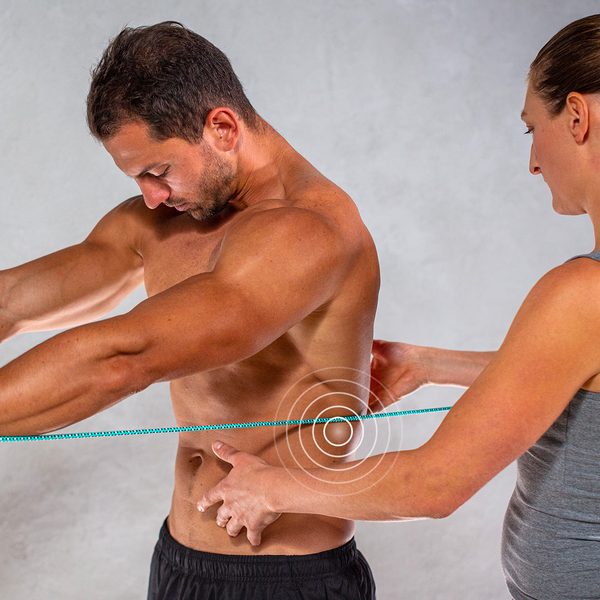
How it shows up
A dull, deep ache low in the back with no sharp beginning. It usually announces itself as stiffness — mornings are harder, putting shoes on no longer reaches as far, and turning to look behind you in the car takes the whole torso.
What separates it from general lower back pain is what gets in your way. There it is pain arriving with a particular movement. Here it is range: the movement simply cannot be finished, and the pain is its limit rather than its cause.
Where it usually comes from
Lumbar vertebrae rotate the least of the whole spine. When the torso needs to turn and the thoracic spine will not allow it — and after days at a desk it will not — the lower back takes over a rotation it is not built for. The small joints between the vertebrae are overloaded, and the body protects them by keeping the surrounding muscles permanently tense.
That tension is the stiffness. It is not weakness, and it will not be fixed by strengthening in the very position that created it — the lower back is already working hard, only on someone else's job.
How spiral stabilisation approaches it
Spiral stabilisation works with the muscle chains that run diagonally across the torso — from one shoulder to the opposite hip. When they engage, they pull the spine upward and handle rotation where there is room for it: in the thoracic spine and the shoulder girdle.
The lower back gets its own job back — carrying, not turning. The stiffness eases on its own once it is no longer needed, which is why the exercises are done standing and moving rather than lying down.
When to see a doctor first
See a doctor before you start exercising if the pain shoots down the leg below the knee, if the leg is getting weak or numb, if there are problems passing urine, or if the pain began after a fall or impact.
Also if the stiffness lasts weeks and does not change through the day — morning stiffness that will not ease with movement should be examined.
Related exercises
Exercises done for lumbar pain. You can read about them here; the full instructions and video are in the Spiralista app.
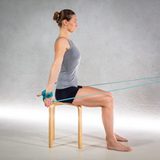
A3 Arrow
Arrow front sitting
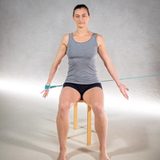
A9 Sideway Arrow
Arrow sideways sitting
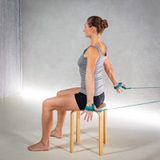
A10 Back Arrow
Back arrow sitting
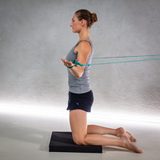
C25 Reeds
Reeds back kneeling
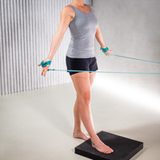
F3 Arrow
Arrow front leg on a mat
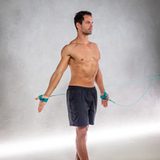
F9 Sideway Arrow
Sideway Arrow leg on a mat
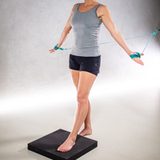
F10 Back Arrow
Back Arrow leg on a mat
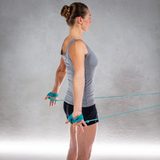
B3 Arrow
Arrow front standing
What to do about it
A guide in the Spiralista app takes you through the exercises for this condition day by day — from the first exercise to the full sequence.
- At homeAn elastic cord and a bit of wall space are enough.
- ShortA few minutes a day, not an hour in the gym.
- Day by dayThe guide shows what comes next today.