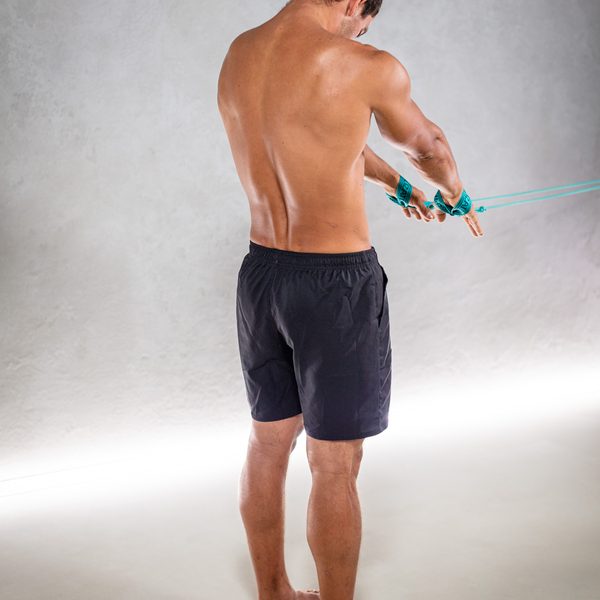
How it shows up
The asymmetry shows from behind in standing: one shoulder higher, one shoulder blade standing out more, the triangles between the arms and the waist not matching, trousers sitting differently on one side. Pain comes later, and more as fatigue after a day on your feet.
Scoliotic posture is not scoliosis. With scoliotic posture the asymmetry evens out on bending forward and the spine is not rotated around its own axis; with scoliosis a hump rises on one side when bending. If this is about your child and you want to know what to check, start with How to recognise scoliosis in children; this page is about what to do once you already know the body is not symmetrical.
Where it usually comes from
The torso is held upright by muscles on both sides. When one side works more — carrying on one shoulder, sitting with a leg tucked under, a one-sided sport, in children a heavy bag in one hand — it starts to pull harder and the spine leans after it.
The body gets used to that position. After a while it is not crooked because something is pulling, but because that is how it has learnt to stand — and without exercise it will not return to vertical on its own. In children during growth spurts it deepens fastest.
How spiral stabilisation approaches it
Spiral stabilisation works with exactly what is missing here: symmetry. The chains cross the body — right arm to left hip and the other way round — and both sides are exercised in alternation, so the difference between them evens out instead of deepening.
The pull of the chains also lengthens the spine upward. A lengthened spine has room to come back to vertical that a compressed one does not — which is why the exercises are done standing and walking, where the crookedness lives.
When to see a doctor first
See a doctor whenever a hump rises on one side when bending forward, when the asymmetry in a child becomes more pronounced within a few months, or when it comes with pain at night or at rest. That is a question for a specialist examination, not for exercising at home.
In children during rapid growth a check is worth it even when nothing hurts — that is exactly when the most can be changed.
Related exercises
Exercises done for scoliotic posture. You can read about them here; the full instructions and video are in the Spiralista app.
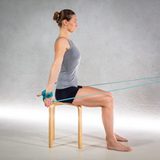
A3 Arrow
Arrow front sitting
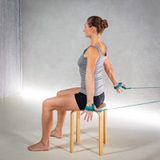
A10 Back Arrow
Back arrow sitting
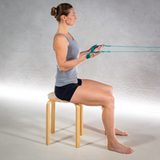
A1 Book
Book front sitting
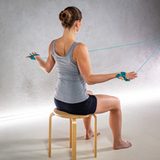
A2 Scales
Scales front sitting
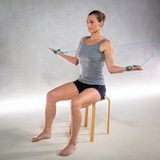
A8 Back Scales
Back Scales sitting
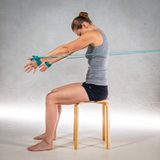
A11 Circles
Circles back sitting
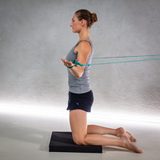
C25 Reeds
Reeds back kneeling
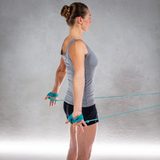
B3 Arrow
Arrow front standing
What to do about it
A guide in the Spiralista app takes you through the exercises for this condition day by day — from the first exercise to the full sequence.
- At homeAn elastic cord and a bit of wall space are enough.
- ShortA few minutes a day, not an hour in the gym.
- Day by dayThe guide shows what comes next today.